zaterdag 13 februari 2016


This is the 22 ft. Falmouth Working Boat I built in 1983. Plans are from Percy Dalton, who was an expert on these boats. I found his name in Pete Greenfields The first ferro boat book and liked the boats very much. The hull is ferrocement and the deck are plywood over laminated larch beams. Sails were made by Patrick Selman who then just started as a sailmaker and he still is a very good sailmaker for gaff rig. I sold the boat in 1989 and lost sight till a few years ago when the owner asked me to do repairs on the sails. I am gratefull he sent me these pictures of the boat on the Lauwersmeer, my own sailing area.

zondag 25 oktober 2015

Data cursussen

Workshop zeil maken                                          12 en 13 december 2015
Workshop canvaswerk                                         23 januari 2016
Workshop zeilreparaties en canvastechnieken       13 februari 2016
Zie voor meer informatie www.oarandsail.nl/cursussen

woensdag 26 november 2014

My own lugger


This spring I launched my own boat. I was inspired by the midframe shape of Joel White's Shellback dinghy, and made a rough drawing of a multichine boat. A narrow flat bottom, three strakes above it, a kind of Swampscott Dory with a wider transom and a plumb bow, so it looked a bit like a Whitehall Dinghy,  and then Klaas Bes, naval architect, got it all on his drawing board or computer. He faired the lines and did the necessary calculations.Moreover, he printed the halfstations on paper, so transferring them to moulds was easy. I built the boat over more then a years spare time in my garage, using 8 mm occoume plywood, for the bottom and 6 mm ply for the 3 strakes. The transom was made out of a piece of birch plywood of 12 mm.
I made the transom slightly hollow wher the first strake landed and since I was not sure how much would look better I gave starboard more hollow than the other. That is the nice thing when you build your own boat: You can do what you like.
I glued the strakes in our living room in winter, using the template I made directly on the moulds. It made laying out the ply easier.
 I took the hull of the moulds and...

...and after some time I had a boat. The mast was a polyester flagpole, the sail was the same as a Ness Yawls main, balanced lug, as I hope to compare the boat with them. The rest of the birch went into a daggerboard and  case.


She sails as I wished she would and than a bit better. Fingertip controll, turns so fast that I win most tacking duels. The rudder is cannibalised from a deceased OK Dinghy, which may explain the odd helm.
 And she is a fine rowing boat

And we also use her till I got the St. Ayels Skiff finished.

maandag 11 augustus 2014

New sail for a Cornish Crabber


Wilko Braam who owns a Sailing School obught a Crabber for his expeditions on shallow water. We both thought the existing old sails had shrunk or the possible lenth of the spars was not optimal used, so we measured it up.
Resulting sails were made in Tanbark Supercruise, crosscut with battens, and bent on. All that is left is the topsail. I used to sail on Falmouth Working Boats with my friend Patrick Selman on his gaff cutter and remembered the often striped topsails the boats had. I ordered some blue and white 4 oz. cloth and hopefully the 'Walvis' with show it soon. Meanwhile she sails very well with her working sails. 

woensdag 11 december 2013


A new lugger for Ben Ullings: A Le Seil designed by Francois Vivier. Instead of the standard boomless standing lug he decided to try a balanced lug and had Vivier design it.
I built it in Supercruise 5.4 oz in the color altair, crosscut with three battens. Not only do you increase the area very slightly but, more important, some roach helps the sail to twist. I also think a slight roach like this is helps to keep a good shape. Often  battenless sails develop a hook to windward.


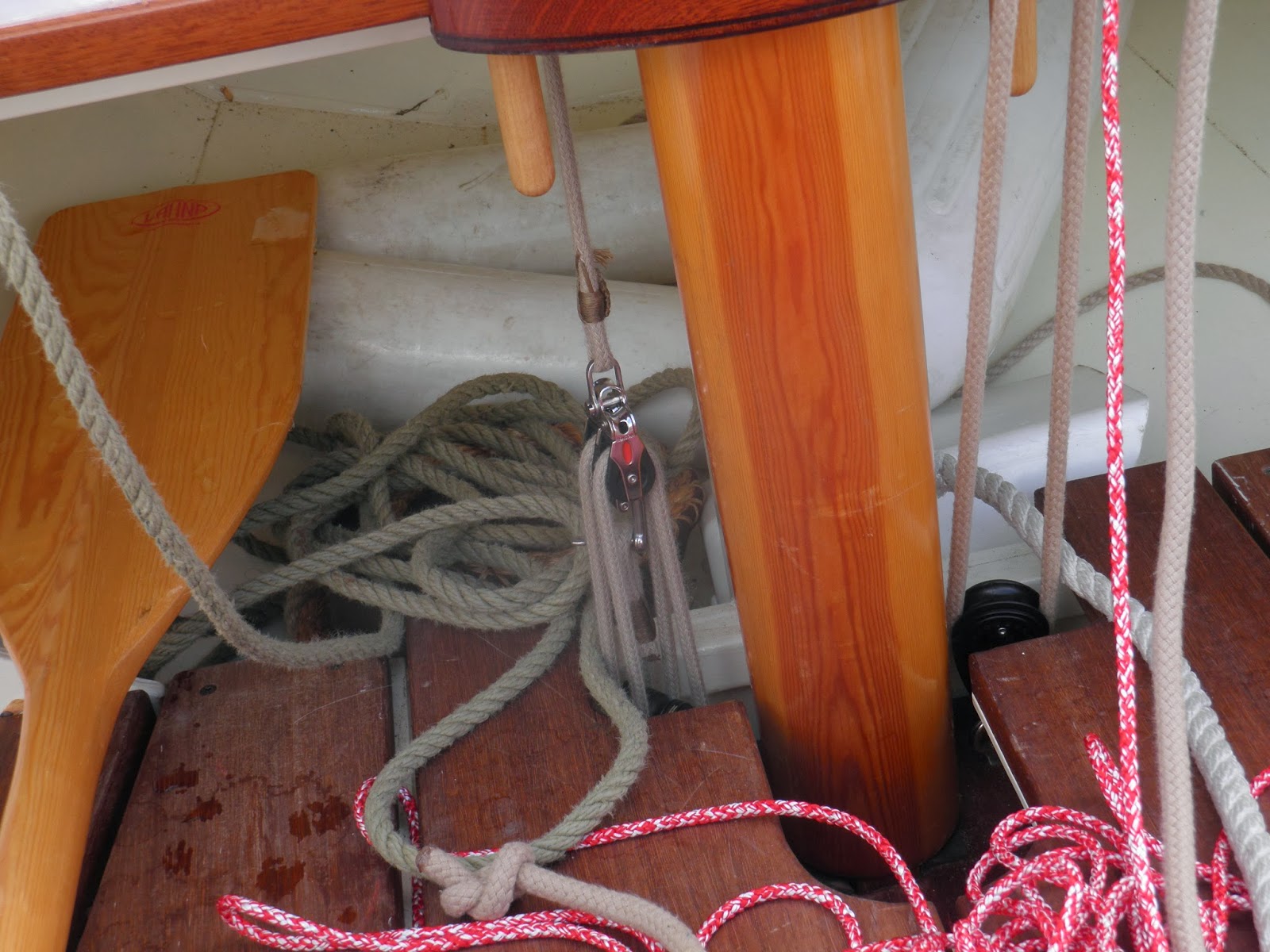
At the left side of the mast he has a powerfull downhaul, while at the right side we see the halyard and the thin red regulation line to controll the yard. Apart from the regulation line there is much dyneema here. I also reinforceed the luff with dyneema..
The line is tied the the yard and goes around the mast to a miniblock and down to the foot of the mast. It is a great help to peak up the yard so the crease, that so often spoils the set of an otherwise good sail, will disappear. I think we have now the same tuning possibilities as gaffers have: Pull on the peak halyard to make the sail fuller and let it go the depower.

I want to tell you Bart Jan Bats, builder of the BJ 17, was the first to use this line to cure an unruly luff: I used prestretched polyesther, thinking it was strong enough: It wasn't and the boat had left the country: He fixed it brilliantly with the reg. line.   

donderdag 3 mei 2012

Open dag

Rob Bouma organizes an "Open day" during the 12th and 13th of may. Interesting for lovers of modern luggers and gaff rig.

 Open proefzeildagen 12 en 13 mei.
Zaterdag 12 mei en zondag 13 mei aanstaande houden Jachtwerf De Zeeg en Zeilcentrum De Windjutter samen open proefzeildagendagen vanuit Waterpark Beulaeke Haven aan de Veneweg 292 te Wanneperveen.
Van Jachtwerf De Zeeg liggen het Visdiefje, de Zwarte Stern en ons laatste ontwerp de Zeeg 480 zeilklaar voor de wal. Zeilcentrum De Windjutter hijst de zeilen van de afgelopen winter ontwikkelde open kielboot de Windjutter 635.
U bent deze dagen van 10.00 tot 16.00 uur harte welkom om deze boten onder zeil uit te proberen.
Van te voren aanmelden moet niet, maar mag wel.
Bij erg slecht weer of volledig gebrek aan wind worden deze proefzeildagen doorgeschoven naar het weekend daarop. Informatie hierover wordt vermeld op onze websites ( www.jachtwerfdezeeg.nl en www.zeilcentrumdewindjutter.nl ).